- The Pre-Read
- Posts
- When the World Feels Unstable, What Do We Choose to Wear?
When the World Feels Unstable, What Do We Choose to Wear?
Gen-Z goes to the mall, the consumer splits in two, AI runs Zalando, and Cavalli may go corporate

Olga Merzlyakova
March 16, 2026
Happy Monday,
I hope you're all doing okay despite what's happening in the world right now. If you're in the Middle East or have family and friends there, I'm thinking of you and wishing everyone safety.
What I find myself wondering now is what the current moment — conflict, AI, economic uncertainty, a generational wealth transfer — will do to our relationship with clothing.
AI can already generate photorealistic images of garments that don't exist. It can design, market, and sell a product before a single thread is cut.
When anything can be fabricated digitally, what happens to our sense of what's worth owning?
When the world feels unstable, do people retreat to the familiar comfort of fast, disposable consumption — or do they move toward things that feel real, traceable, and lasting? I think we're going to see both, but I believe strongly that the pull toward authenticity will only grow.
Through every major shift — whether cultural, political, or technological — people have always sought out objects that carry meaning beyond their function. A garment with provenance, with craft you can see and feel, with a history that predates whatever crisis is unfolding — that's not just fashion. It's a small act of grounding in an ungrounded world.
Take care of yourselves.
Caught my eye
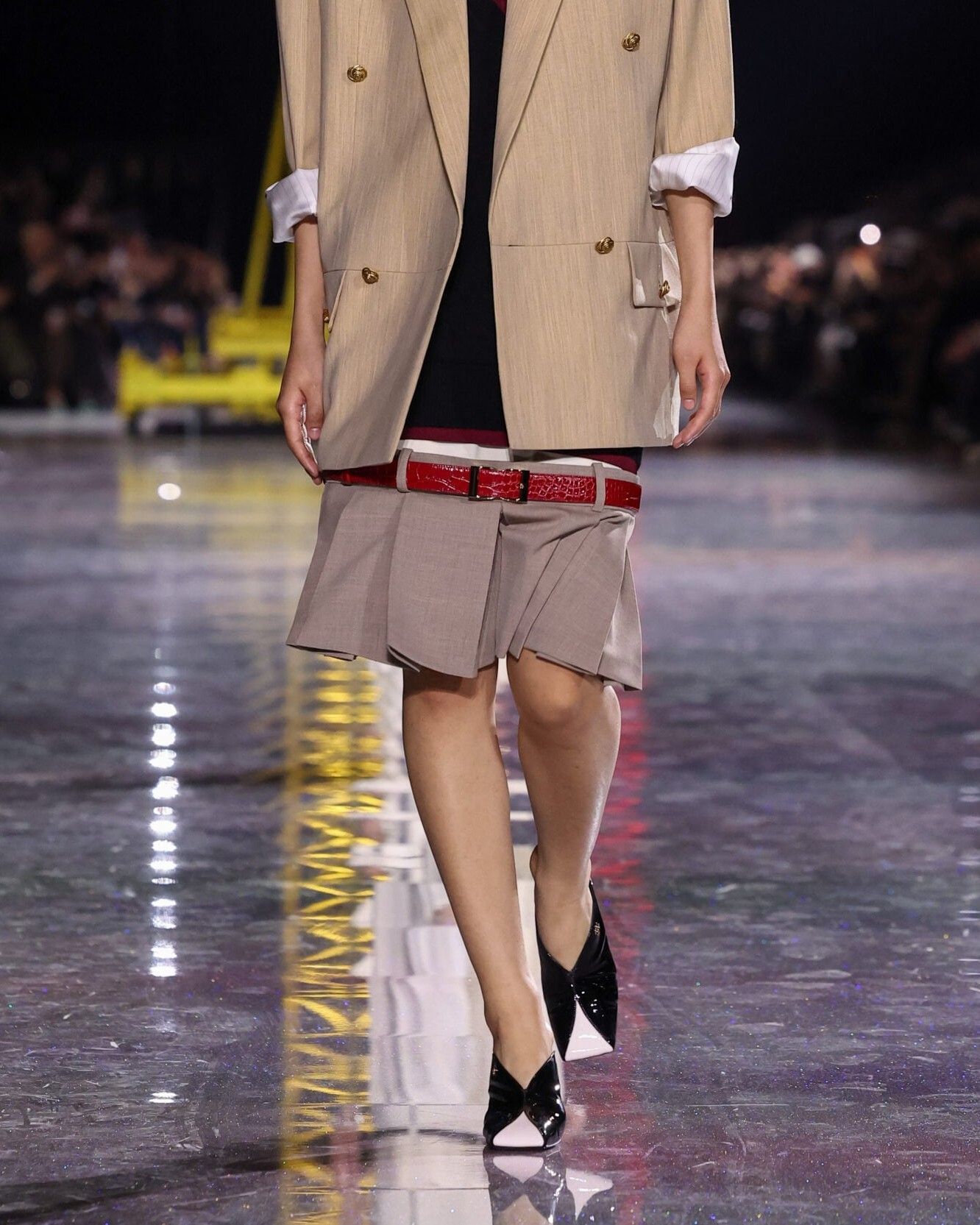
From Chanel’s latest show: how low can the “low waistline” go?
Trends — what’s bubbling underneath the headlines
GenZ goes to the mall
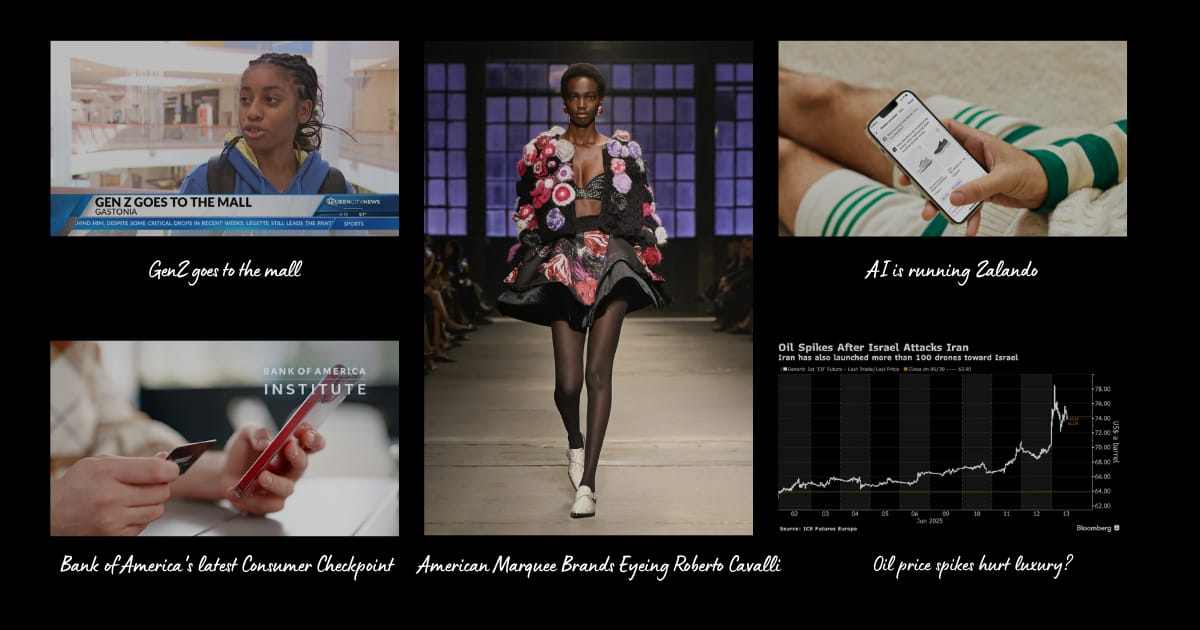
Interesting trend I read about this week in the WSJ. A ray of hope for retailers: Gen Z is actually going to the mall.
We're used to thinking of them as the digital generation — grew up with smartphones, surely they'd be the most online shoppers of all. But the opposite is true. Shoppers ages 18 to 24 made 62% of their purchases in physical stores last year, ten points higher than older generations.
It just reminded me of that "Let's Go to the Mall" song from How I Met Your Mother. The only difference is that the mall has to be Instagrammable now and the experience is more important than the product.
Consumer spending is booming — if you’re rich
Bank of America's latest Consumer Checkpoint is out. February spending growth hit 3.2% year-over-year — the highest in over three years. That sounds great. But look closer.
The story is a K-shaped recovery. Higher-income households are spending more. Lower-income households are barely keeping up. The gap between them isn't closing — divergence in wage growth is driving it, and that's not changing any time soon.
The top third of households by income still drives more than half of consumer spending. Everyone else is managing.
Business moves, big numbers & “wait, what?”
If oil prices spike, will it hurt luxury — or just squeeze everyone else out?
Brent crude just logged its biggest weekly gain on record.
The immediate impact according to Reuters: Chalhoub Group, which runs 900 stores for Versace, Jimmy Choo, and Sephora across the Middle East, made staff attendance voluntary. Kering temporarily closed stores in the UAE, Kuwait, Bahrain, and Qatar. A missile damaged Dubai's Fairmont Palm hotel.
The Middle East is only 5-10% of global luxury spending. But it was luxury's brightest performer last year. And here's the part that won't show up in earnings until summer: if Gulf shoppers can't fly to Paris or Milan post-Ramadan, European luxury sales take a hit too.
Then there's the supply chain. Polyester, nylon, shipping — all oil-linked. Freight costs spike fast. They come down slow. Luxury brands can absorb the margin pressure. Most others can't.
AI is running Zalando
Zalando had a strong 2025. Revenue up 17%. Profit up 16%.
But here's the number that caught my attention: AI now generates 90% of Zalando's marketing content. A year ago, it was close to zero. Campaign production that used to take six weeks now takes days. Output is up 70%.
And it's not just marketing. AI models improved their delivery promise accuracy by 22 percentage points. Their 3,000-person tech team saw a 20% increase in coding output using AI tools. The Zalando Assistant — their AI shopping companion — now has six million users, four times more than last year.
This is what it looks like when a company actually operationalizes AI at scale.
Marquee Brands is reportedly eyeing Roberto Cavalli. The American brand management company — which owns Martha Stewart, Laura Ashley, and others — is rumoured to be taking control of the Italian fashion house.
Cavalli's current owner, Dubai property developer Hussain Sajwani, has shifted his attention to AI data centers. Fashion, apparently, is no longer the priority.
The brand itself is doing quite well. A relatively new creative director has been leaning into the founder's original vision, dressing celebrities like Taylor Swift, Beyoncé, and Lady Gaga.
But Marquee is in the business of licensing. They own brands and work with networks of partners for everything else. If this deal happens, I wonder whether the fashion house, in the traditional sense, will continue to exist.
Wish I were there - pop-ups, collabs, etc.
Pencil in, book the ticket, or just follow on social media — choose your option and let’s discuss afterwards!
20.03.-21.03.26 | Paris - Fondation Cartier Performance by Olivier Saillard with Tilda Swinton
Thanks for reading! Have a great week.
Next steps
Please feel free to get in touch. I’d love to hear from you!
Forward this e-mail to a colleague or a friend
Read other content here
Reply